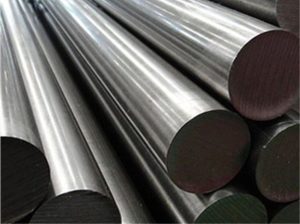
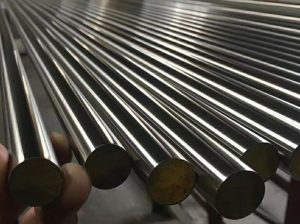
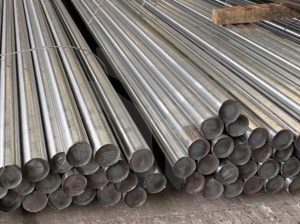
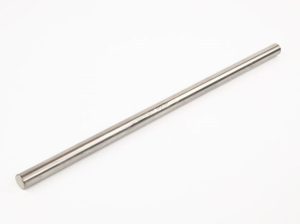
Aerospace fasteners, gas turbine components, and high-pressure oil and gas hardware share one requirement: they must hold their strength when everything around them works to weaken it. Alloy A286 round bar meets that requirement through a precipitation-hardenable iron-nickel-chromium composition that retains strength above 650°C while resisting oxidation and corrosion. Engineers choose this material when temperatures rule out stainless steel and full nickel superalloys cost more than the task justifies. This guide covers the properties, specifications, and selection factors behind an a286 round bar.
What Is an Alloy A286 Round Bar?
Alloy A286 round bar carries the designation UNS S66286 and belongs to the iron-nickel-chromium superalloy family, not the 300-series stainless steels used for general-purpose service. It strengthens through precipitation hardening: titanium and aluminum additions form intermetallic compounds during aging that lock the microstructure in place. Grade 304 or 316 softens above 500°C, while A286 continues to work past that point, so buyers sourcing an A286 stainless steel bar for turbine requirements look beyond general-purpose stainless.
Key Properties of Alloy A286 Round Bar
High Temperature Strength
A286 retains tensile strength above 900 MPa at room temperature and performs up to 700°C, matching turbine blade demands.
Corrosion and Oxidation Resistance
Chromium near 15% forms a stable oxide layer that resists scaling up to 815°C and outlasts carbon steel in marine exposure.
Creep and Stress Rupture Resistance
A286 resists creep longer than most stainless grades, sitting between stainless steel and nickel alloy round bars on cost.
Good Mechanical Strength
Yield strength above 600 MPa combines with elongation near 20%, resisting brittle failure and shock deformation.
Weldability and Machinability
TIG and resistance welding work well with correct post-weld aging. Machining needs rigid tooling, since the alloy work-hardens.
Common Specifications and Standards
UNS S66286 sets the chemical baseline for the mills’ reference. ASTM A638 covers general bar stock, while AMS 5731, AMS 5732, and AMS 5737 address aerospace bar, forging stock, and cold-finished condition. EN 1.4980 gives the European equivalent. Aerospace contracts call out AMS specifications directly; industrial buyers accept ASTM A638 certification, much like sourcing from our Stainless Steel Round Bars range.
Heat Treatment of Alloy A286 Round Bar
A286 round bar goes through a two-stage process. Solution annealing heats the bar to roughly 980°C and cools it rapidly, dissolving the alloying elements into a uniform structure. Age hardening follows near 720°C, precipitating the compounds that lock in strength and lift durability above the annealed condition.
Common Applications of Alloy A286 Round Bar
Aerospace manufacturers specify A286 for turbine discs, blades, and fasteners for its stability through thermal cycling. Gas turbine builders lean on the same creep resistance for oxidation hardware. Automotive engineers use it in turbocharger fasteners, where standard steel would relax and lose clamp load. Power plants specify it for turbine bolting; oil and gas operators use it for valve components in sour service.
Alloy A286 Round Bar vs Other High-Performance Alloys
Matching conditions to material strengths settles most decisions.
| Material | Primary Advantage | Best Application |
| Alloy A286 | High-temperature strength | Aerospace & turbines |
| 316 Stainless Steel | Corrosion resistance | Marine & chemical |
| 17-4 PH Stainless Steel | High strength | General engineering |
| Inconel 718 | Extreme temperature resistance | Aerospace & power generation |
Factors to Consider Before Selecting an A286 Round Bar
Confirm the maximum operating temperature the component will face. Calculate the mechanical load and cycling pattern it must withstand. Assess corrosion exposure at the installation site. Specify the exact standard, since AMS and ASTM differ on traceability. Request the correct heat-treated condition. Account for size early, since larger diameters need longer aging cycles.
Conclusion
Alloy A286 round bar earns its place in aerospace, turbine, and high-pressure applications because it holds strength and resists oxidation and creep at temperatures that defeat stainless steel. Full value comes from specifying the right standard, ASTM A638 for industrial use or AMS for aerospace work, and the correct heat-treated condition.
FAQs
What is Alloy A286 round bar used for?
Aerospace fasteners, gas turbine components, and high-temperature bolting in oil and gas equipment.
What makes Alloy A286 suitable for high-temperature applications?
Precipitation hardening through titanium and aluminum holds strength above 700°C without excessive softening.
Is Alloy A286 better than 316 stainless steel?
A286 offers higher strength and creep resistance at heat; 316 stays cheaper for corrosion-only service.
Can Alloy A286 round bars be heat treated?
Yes. Mills solution anneal the bar near 980°C, then age it near 720°C for full properties.
Which industries commonly use A286 stainless steel bars?
Aerospace, gas turbine manufacturing, oil and gas, power generation, and chemical processing specify this grade.